AirTags vs BLE Tags: Which Is Best for Business Asset Tracking?

AirTags vs BLE Tags for Business Asset Tracking
AirTags are a popular choice for finding personal items such as keys, bags, wallets, and luggage. They are small, affordable, and easy to use with an iPhone. For personal use, they can be very useful.
However, when it comes to business asset tracking, AirTags have clear limitations. Many companies consider using AirTags because they appear to be a low-cost tracking option, but they are not designed for commercial asset management, fleet operations, equipment tracking, or industrial monitoring.
For businesses that need reliable visibility across tools, machinery, vehicles, stock, or equipment, Bluetooth Low Energy tags, also known as BLE tags, are a much better solution.
Key Takeaways
AirTags are designed for personal item recovery, not business asset tracking.
AirTags rely on Apple’s Find My network and are built around personal use. They do not provide the level of control, reporting, shared access, integration, or continuous operational visibility that most businesses require.
BLE tags are purpose-built for commercial tracking.
Bluetooth Low Energy tags can be used with business tracking platforms, gateways, vehicle trackers, and cloud systems. They can also support additional sensors such as temperature, humidity, motion, pressure, and door status.
A proper Bluetooth asset tracking system gives businesses scalable visibility.
A complete system combines BLE tags, BLE-enabled trackers or gateways, and a cloud platform. This allows businesses to track assets across multiple sites, vehicles, warehouses, and customer locations.
What are AirTags?
AirTags are small Bluetooth tracking devices designed to help people find personal belongings. They work through Apple’s Find My network, allowing iPhone users to locate an item on a map when it has been detected by nearby Apple devices.
This makes AirTags useful for everyday personal items such as keys, handbags, luggage, and backpacks.
The problem is that personal item recovery is very different from business asset tracking. A business may need multiple staff members to access asset data, track hundreds or thousands of items, monitor movement between locations, generate reports, receive alerts, and integrate data into fleet, warehouse, or job management systems.
AirTags are not built for this type of commercial environment.
Why AirTags Are Limited for Business Asset Tracking
At first glance, AirTags may seem like a cheap way to track business assets. They are easy to buy, simple to set up, and familiar to many iPhone users. But once a business tries to use them for real asset tracking, the limitations quickly become clear.
1. They Depend on the Apple Find My Network
AirTags do not send their location directly to a business tracking platform. Instead, they rely on nearby Apple devices to detect them and update their location through the Find My network.
This means tracking depends on whether there are compatible Apple devices nearby. In busy public areas, this may work well. In remote sites, warehouses, yards, farms, construction areas, or industrial locations, location updates may be less reliable.
For business asset tracking, relying on random nearby devices is not ideal. Businesses usually need a more controlled system where data is collected by their own trackers, gateways, or installed infrastructure.
2. Limited Business Access and User Control
AirTags are managed through Apple’s ecosystem. While sharing options are available, they are still designed around personal use rather than full business team management.
A business asset tracking system should allow multiple users, roles, permissions, departments, reports, alerts, and account-level control. For example, a fleet manager, warehouse manager, service engineer, and office administrator may all need different levels of access.
AirTags do not provide a proper business dashboard for managing large numbers of assets across teams and locations.
3. No Business Reporting or System Integration
AirTags are not designed to integrate with fleet management platforms, IoT dashboards, job management software, ERP systems, or maintenance systems.
Businesses often need more than just a location on a map. They may need reports showing:
When an asset was last seen
Which vehicle or site it was near
How often it moved
Whether it entered or left a location
How long it stayed in one area
Whether temperature or humidity went outside limits
Whether equipment is being used efficiently
AirTags do not provide this type of operational data or reporting.
4. No Environmental Monitoring
AirTags are mainly location-focused devices. They are not designed to monitor environmental or operational conditions such as temperature, humidity, pressure, shock, door opening, or equipment movement.
This is a major limitation for industries such as food distribution, healthcare, pharmaceutical logistics, cold chain monitoring, construction, and plant hire.
For example, a company transporting chilled goods may need to know not only where an asset is, but whether it stayed within the correct temperature range. An AirTag cannot provide that level of monitoring.
5. Unwanted Tracking Alerts Can Cause Problems
AirTags include safety features to help prevent unwanted tracking. This is important for privacy, but it can create problems in business use cases.
For example, if a rental company placed AirTags in vehicles, customers or staff with iPhones may receive alerts telling them that an AirTag is moving with them. This can cause confusion, concern, or unnecessary support calls.
For commercial tracking, businesses need a system that is clearly designed for asset monitoring, customer transparency, and operational use.
Example: Why AirTags Can Fail in a Rental Business
Imagine a rental company using AirTags to track vehicles, tools, or machinery.
At first, the solution may appear to work. The company can see a rough location when the AirTag is detected by nearby Apple devices. But over time, several issues may appear:
Location updates may be inconsistent in rural areas or low-traffic sites
Staff cannot access a proper business tracking dashboard
Customers may receive unwanted tracking notifications
There is no usage history or movement reporting
There are no temperature, humidity, or motion sensor options
The data cannot be easily integrated with rental management software
Managing large numbers of AirTags becomes difficult
This is why AirTags may be suitable for personal belongings, but they are not the right tool for serious business asset tracking.
What Are BLE Tags?
Bluetooth Low Energy tags, or BLE tags, are small wireless devices designed to help businesses track and monitor assets.
Like AirTags, BLE tags use Bluetooth technology. The difference is that BLE tags are designed to work as part of a wider business tracking system. They can connect to BLE-enabled vehicle trackers, gateways, smartphones, or fixed receivers. These devices then send the data to a cloud-based platform where it can be viewed, managed, and reported on.
BLE tags are commonly used to track:
Tools
Equipment
Machinery
Medical devices
Pallets
Containers
Vehicles
Trailers
Rental assets
Temperature-sensitive goods
Stock and inventory
Unlike AirTags, BLE tags are not limited to one consumer ecosystem. They can be used with a range of tracking platforms and business systems.
Advantages of BLE Tags for Business
1. Scalable Asset Tracking
BLE tags are ideal for businesses that need to monitor many assets across different locations. A company can tag hundreds or thousands of items and collect data through gateways, vehicle trackers, or site-based receivers.
This makes BLE tracking suitable for businesses with large inventories, mobile teams, multiple vehicles, or several depots.
2. Multi-User Business Access
A BLE asset tracking system can provide access to multiple users through a cloud dashboard. Different staff members can view asset data, receive alerts, run reports, and manage assets based on their role.
This is much more suitable for business operations than a personal tracking app.
3. Works with Gateways and Vehicle Trackers
BLE tags do not usually send data directly to the cloud on their own. Instead, they are read by a BLE-enabled gateway, GPS tracker, or other connected device.
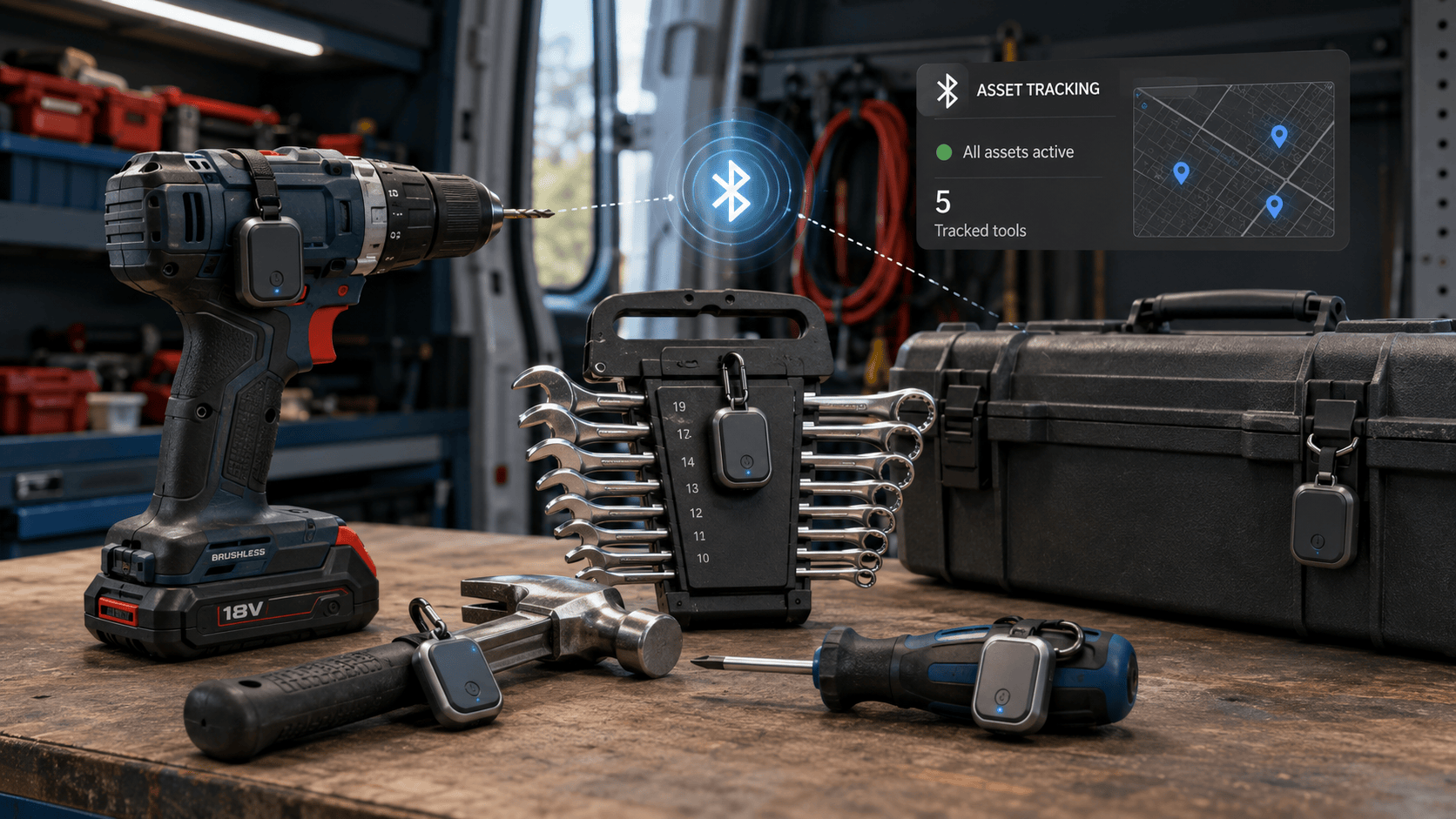
For example, a BLE tag attached to a tool can be detected by a vehicle tracker installed in a van. The system can then show which tools are in the vehicle, when they were last seen, and where the van was at that time.
This is useful for service fleets, construction companies, maintenance teams, and rental businesses.
4. Sensor Options for More Valuable Data
Many BLE tags can do more than location tracking. Depending on the model, they can monitor:
Temperature
Humidity
Motion
Door opening
Pressure
Shock or impact
Asset movement
Presence or absence
This gives businesses more useful information about their assets and operating conditions.
For example, a cold chain company can use BLE temperature tags to monitor chilled or frozen goods. A construction company can use BLE tags to monitor tools and equipment. A facilities team can use BLE sensors to monitor doors, rooms, storage areas, or environmental conditions.
5. Better Integration with Business Systems
BLE asset tracking systems can be connected to cloud platforms, fleet management software, IoT dashboards, reporting tools, and alert systems.
This allows businesses to create real operational value from asset data. Instead of simply seeing where an item might be, a business can understand how assets are being used, where they are located, and when action is needed.
How a Bluetooth Asset Tracking System Works
A proper Bluetooth asset tracking system usually includes three main parts.
1. BLE Tags
BLE tags are attached to the assets you want to track. These tags transmit Bluetooth signals that can include identification data and sensor readings.
For example, a BLE tag may send its unique ID, temperature reading, battery level, and movement status.
2. BLE Gateways or BLE-Enabled Trackers
The BLE tag itself does not normally send data directly to the cloud. It must be read by a gateway, GPS tracker, smartphone, or receiver with Bluetooth capability.
These devices collect data from nearby BLE tags and send it to the cloud using mobile data, Wi-Fi, Ethernet, or another network connection.
3. Cloud-Based Tracking Platform
The cloud platform stores and displays the data. Users can log in to view asset locations, run reports, set up alerts, check sensor readings, and manage assets across multiple sites.
This gives businesses a central place to monitor equipment, vehicles, stock, and sensors.
Example: BLE Tracking for Fleet and Tools
A company with a fleet of vans may want to know which tools are in each vehicle.
By attaching BLE tags to tools and installing BLE-enabled GPS trackers in the vans, the business can automatically detect which tools are present. If a tool is removed from a van or left behind at a site, the system can show where it was last detected.
This helps reduce lost tools, improve accountability, and save time checking equipment manually.
The same approach can be used for machinery, rental equipment, medical assets, trailers, containers, and temperature-sensitive goods.
Bluetooth Asset Tracking Applications
BLE asset tracking can be used across many industries.
Healthcare
Hospitals and healthcare providers can use BLE tags to track medical equipment, trolleys, devices, and other important assets. This helps staff locate equipment faster, reduce loss, and improve operational efficiency.
Logistics and Cold Chain
Logistics companies can use BLE tags and sensors to monitor goods, pallets, containers, and temperature-sensitive products. This is especially useful for food, pharmaceutical, and chilled distribution.
Construction
Construction companies can track tools, machinery, small equipment, and site assets. BLE tags can help reduce theft, improve utilisation, and make it easier to locate equipment across job sites.
Retail and Warehousing
Retailers and warehouses can use BLE tracking to improve inventory visibility, locate stock, monitor movement, and reduce time spent searching for items.
Rental and Plant Hire
Rental companies can use BLE tags to track vehicles, machinery, tools, and other rented assets. This helps monitor usage, reduce loss, and improve asset return processes.
Facilities and Industrial Sites
BLE tags and sensors can be used to monitor equipment, rooms, doors, environmental conditions, and mobile assets within facilities, factories, and industrial locations.
AirTags vs BLE Tags: Which Is Better for Business?
AirTags are useful for personal belongings, but they are not designed to replace a business asset tracking system.
For businesses, BLE tags offer a more flexible and scalable solution. They can work with GPS trackers, gateways, cloud platforms, reports, alerts, and sensors. They also give businesses better control over how asset data is collected, shared, and used.
AirTags may help you find a lost bag or set of keys. BLE tags can help a business manage equipment, protect assets, monitor conditions, and improve operations.
Contact Us for a Bluetooth Asset Tracking Solution
If your business needs a reliable way to track tools, equipment, vehicles, stock, or temperature-sensitive assets, a Bluetooth asset tracking system can provide a scalable and flexible solution.
At iotolutions , we provide BLE tags, BLE-enabled tracking devices, gateways, and cloud-based monitoring systems for businesses across Ireland.
Whether you need to track assets in vehicles, warehouses, job sites, rental fleets, or cold chain operations, we can help design a system that suits your business.
Contact us today to discuss a Bluetooth asset tracking solution for your business.